
A fixed mortgage rate ending is not only a rate-shopping event. It is a deadline involving your current lender, possible alternative lenders, property value, affordability evidence, fees, early repayment charges, and the practical risk of falling onto a reversion rate while paperwork is incomplete. The safest approach is to start early enough to compare complete costs without making a rushed decision.
This guide explains a UK-focused preparation process. It does not recommend a particular product or lender. A product transfer with your current lender, a remortgage to a new lender, remaining on the reversion rate, changing the mortgage term, or seeking support can have different consequences. A regulated mortgage adviser or the lender can help where the choice depends on personal circumstances.
Start with the exact end date and reversion terms
Find the mortgage offer, latest annual statement, or secure-message confirmation showing when the current deal ends. Do not rely on the month alone. Record the exact date, the current rate, the rate that applies afterwards, and any early repayment charge period. A deal ending on 2 October creates a different payment and timing problem from one ending on 30 October.
Also confirm whether the reversion rate is the lender's standard variable rate, a tracker, or another product-specific rate. Reversion rates can change, so a figure copied months earlier may no longer be current. Ask the lender what payment would apply if no new deal were arranged and when that payment would first be collected.
Build a six-month preparation timeline
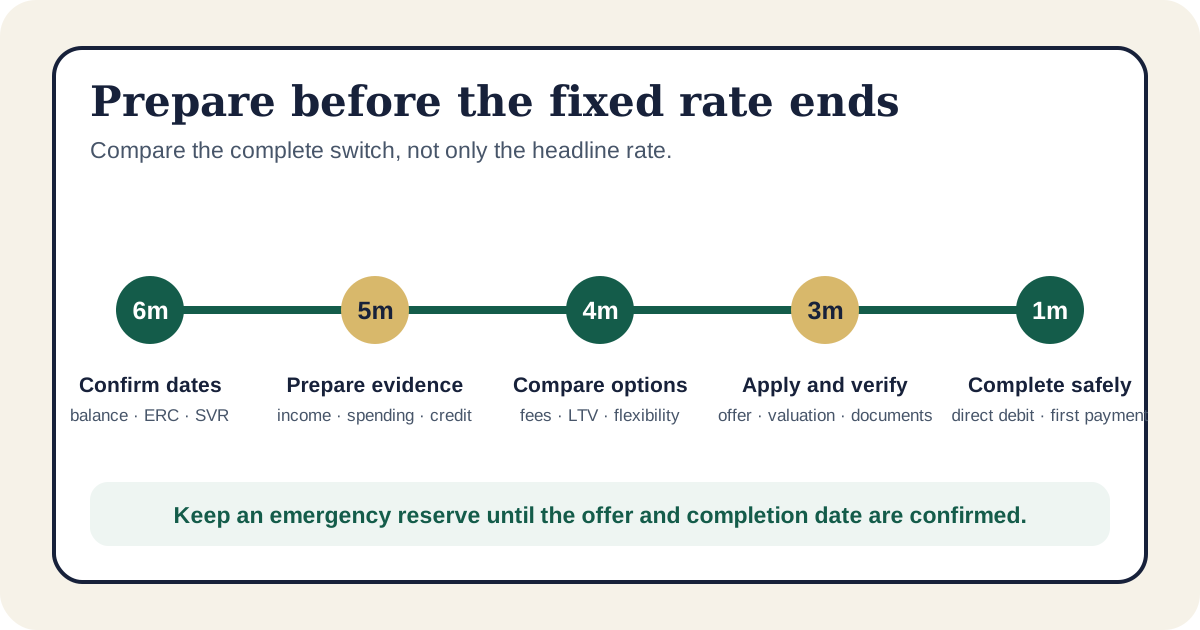
MoneyHelper advises reviewing options up to six months before a fixed or discounted deal ends. Six months is a planning window, not a universal application deadline. Some lenders allow an existing customer to reserve a rate for a period, while a new lender's offer may have its own validity period. Create a dated checklist rather than assuming every provider works to the same timetable.
- Six months before: confirm the end date, current balance, remaining term, repayment type, early repayment charge, and likely property value.
- Five months before: check credit files for errors, collect income evidence, review regular commitments, and identify any known changes such as parental leave or retirement.
- Four months before: compare the current lender's product-transfer choices with remortgage options, including fees and incentives.
- Three months before: decide whether advice is needed, submit an appropriate application, and respond quickly to document requests.
- One month before: confirm the completion date, direct debit, final payment on the old deal, and whether any fee is being paid upfront or added to the balance.
- After completion: check the first payment, updated balance, rate, term, and any overpayment instructions.
Compare total cost, not the headline rate
A lower rate can still produce a higher short-term cost when it carries a product fee, valuation charge, legal cost, broker fee, or an early repayment charge for leaving the old deal too soon. Cashback and free legal work can reduce costs, but their conditions matter. Compare options over the period you expect to keep the new deal rather than over the whole mortgage term if you are likely to switch again.
For each option, record the monthly payment, product fee, fees added to the mortgage, legal and valuation costs, cashback, exit fee, and any early repayment charge. Adding a fee to the mortgage avoids an upfront payment but means the fee becomes part of the balance on which interest may be charged.
| Comparison item | Current-lender transfer | New-lender remortgage | Reversion rate |
|---|---|---|---|
| Initial rate and end date | Record offer | Record offer | Confirm current rate |
| Monthly payment | Confirmed figure | Confirmed figure | Confirmed estimate |
| Product and advice fees | Include all | Include all | Usually none to remain |
| Legal and valuation costs | Check | Check | Not applicable |
| ERC or exit cost | Check timing | Check timing | Check old deal |
| Overpayment flexibility | Read new terms | Read new terms | Read current terms |
Estimate loan-to-value carefully
Loan-to-value, or LTV, compares the mortgage balance with the property's value. It can affect which products are available, but an online property estimate is not the same as a lender valuation. Calculate a planning figure by dividing the expected mortgage balance by a realistic property value and multiplying by 100. Then test a lower property valuation as well as your preferred estimate.
For example, a £186,000 balance against an estimated £240,000 property value produces a planning LTV of 77.5%. If the lender values the property at £225,000, the LTV becomes about 82.7%. That difference may alter the product range. Do not commit an emergency fund to an overpayment purely to cross an assumed LTV boundary until the valuation and product rules are clear.
Prepare evidence before the application
A new lender may ask for payslips, bank statements, accounts or tax calculations, proof of deposit or capital, identification, and details of credit commitments. Requirements vary according to employment type and circumstances. Save complete, readable documents and make sure names, addresses, and income figures are consistent.
Review bank statements as an affordability record, not something to cosmetically tidy for an application. Regular spending, childcare, maintenance, subscriptions, credit payments, and overdraft use affect the household budget whether or not an underwriter asks about each item. A sustainable payment matters more than forcing an application through.
Check credit reports for factual errors
Checking your own credit report does not mean applying repeatedly. Review the information held by the main credit-reference agencies and dispute factual errors through the appropriate process. Do not pay a company to remove accurate negative information or create a misleading application. If recent missed payments or an arrangement exist, explain the circumstances truthfully to a regulated adviser or potential lender.
Decide whether to overpay before the switch
An overpayment can reduce the balance and perhaps the planning LTV, but it also reduces accessible cash. Check the current deal's allowance and early repayment charge before paying. Then check whether the new application uses the balance before or after the overpayment and whether the money would be more useful for fees, repairs, moving costs, or an emergency reserve.
Use the mortgage calculator to test the balance and payment effect, but do not treat a modelled LTV improvement as proof that a lender will offer a specific product. The valuation, lending criteria, income assessment, and product availability still decide the outcome.
Product transfer and remortgage are different processes
A product transfer generally means selecting a new deal from the existing lender without moving the mortgage to another lender. It may involve a simpler process, but the available rates, fees, term choices, and eligibility rules still need checking. A remortgage moves the borrowing to another lender and may involve underwriting, valuation, conveyancing, and more documents.
Neither route is automatically better. A product transfer can be valuable when speed or eligibility is a concern. A remortgage can offer a wider market. Compare the complete outcome and the risk of delay, not the label.
Plan for payment shock before choosing the deal
Calculate the new payment and the difference from the current direct debit. Test at least three rates: the offered rate, a moderately higher rate at the next review, and the lender's current reversion rate. Add known changes to council tax, energy, childcare, insurance, and other debts. A payment that is technically affordable on today's figures can become fragile when several costs rise together.
If the expected payment is difficult, contact the lender before missing a payment. The FCA explains that lenders should provide support tailored to circumstances. Temporary changes can increase the total repaid or affect the credit file, so ask for the consequences in writing.
Worked example: compare a fee-free deal with a lower rate
A borrower owes £186,000 with 21 years remaining. The current fix ends in five months. Option A is a product transfer at 4.70% with no product fee. Option B is 4.48% with a £1,499 fee added to the mortgage. The lower rate is not enough information. The borrower compares monthly payments and total cash over the intended two-year deal, includes interest on the added fee, and checks whether a new valuation could change eligibility.
The household also models the lender's reversion rate as a contingency. It keeps the emergency fund untouched until the offer and completion date are confirmed. This prevents a small rate advantage from creating a cash shortage during the switch.
Completion checks people commonly miss
- Confirm whether the old lender will collect another direct debit near completion.
- Check whether the conveyancer needs a small shortfall before completion.
- Do not cancel the old direct debit until completion and payment allocation are confirmed.
- Check the first new payment date because it can differ from the normal monthly date.
- Confirm whether fees were paid upfront or added to the mortgage.
- Recreate any regular overpayment instruction under the new product.
- Keep the offer, completion statement, redemption statement, and first new statement.
When regulated advice is particularly useful
Consider regulated mortgage advice where income is variable, the term runs into retirement, the mortgage is interest-only, there are credit problems, the property is unusual, affordability is tight, debt consolidation is proposed, or the household is choosing between materially different repayment structures. Advice can also help explain protection, fees, and product restrictions.
Bottom line
Start with the exact fixed-rate end date and the payment that applies if nothing changes. Compare complete costs, prepare evidence, stress-test the household budget, and keep enough cash for disruption. A successful remortgage is not merely the lowest rate displayed on a comparison screen; it is a completed, affordable arrangement whose fees, term, flexibility, and risks have been understood.
Worked example: test the next payment before choosing a deal
A borrower owes £186,000 with 21 years remaining. They compare a fee-free product transfer at 4.70% with a 4.48% remortgage carrying a £1,499 fee, then test the lender's reversion rate as a contingency. The fee, valuation, timing and cash reserve are compared alongside the monthly payment.
Sources and further checking
Sources were checked on 27 July 2026. Provider pages illustrate product-specific practice and should not be treated as universal rules.
How this guide was produced
Pay Off Sooner may use software and generative AI to organise research, test structure, identify repeated wording and support drafting. The page is not published solely because an automated system produced text. Conor Dwyer selects the topic, checks cited sources, reviews calculations and examples, removes unsupported claims and accepts responsibility for corrections. Read the full editorial and automation policy.