
Mortgage payment shock is the gap between the payment a household is used to and the payment required after a rate change, product expiry, temporary support arrangement, or change in mortgage terms. It is not limited to dramatic market movements. A moderate rate increase can be difficult when childcare, energy, insurance, food, and other credit commitments have risen at the same time.
This guide shows how to calculate the size of the change, test the household budget, and prepare a response before a payment is missed. It provides educational planning, not a recommendation to change a mortgage. Product choices and support arrangements can affect total cost, term, and credit-file reporting, so confirm the consequences with the lender or a regulated adviser.
Identify the event that could change the payment
Payment shock can follow several different events. A fixed or discounted deal may end and revert to the lender's reversion rate. A tracker can move with its reference rate. A lender may recalculate payments after a rate change, annual review, overpayment, term change, or temporary arrangement. An interest-only borrower may also face a capital repayment deadline even when the monthly interest payment has been affordable.
Write down the trigger, expected date, current balance, remaining term, repayment type, current payment, and the rate or payment that may apply afterwards. Do not model a repayment mortgage as interest-only or assume a lender will leave the term unchanged after a variation.
Calculate the payment gap in pounds and as a percentage
The useful starting number is the monthly cash difference. Subtract the current mortgage payment from the expected new payment. Then divide the difference by the current payment to understand the percentage increase. The percentage can show scale, but the pounds determine whether the budget works.
For example, a payment rising from £890 to £1,140 increases by £250 a month, or about 28%. A household with £500 of genuine monthly headroom may absorb that after revising priorities. A household with only £80 of headroom cannot solve it by describing the increase as temporary.
Use at least three scenarios
A single forecast creates false certainty. Model a lower, central, and higher payment scenario. For a fixed-rate expiry, the scenarios might use an available product-transfer rate, a realistic alternative deal including fees, and the current reversion rate. For a tracker, use the current payment plus one or two additional rate steps as a resilience test.
Keep the balance and term consistent while comparing rates, then model any proposed term change separately. Extending the term can lower the monthly payment but may increase total interest and push repayment later in life. Mixing the rate and term changes in one calculation makes it hard to see which choice produced the result.
Build a payment-shock budget from transactions
Use recent bank and card statements rather than memory. Separate essential commitments, priority bills, flexible spending, annual costs, and debt payments. Convert annual costs such as car insurance, boiler servicing, school items, or professional fees into monthly amounts. Include irregular but predictable spending so it does not appear as a surprise after the mortgage changes.
| Budget layer | Examples | Action |
|---|---|---|
| Priority and essential | Mortgage, council tax, utilities, food, essential transport | Protect first |
| Contractual credit | Loans, cards, car finance | Record required payment and rate |
| Annual and irregular | Insurance, repairs, school costs | Create monthly reserve |
| Flexible | Subscriptions, eating out, non-essential shopping | Review realistically |
| Safety margin | Emergency saving and unplanned costs | Do not set to zero |
Do not create an apparently balanced budget by excluding maintenance, medical travel, children's costs, or every discretionary item. A plan that can only work in a perfect month will fail repeatedly.
Run the new payment before it arrives
When the expected payment is known, transfer the difference between the current and future payments into a separate savings pot each month. This “practice payment” tests whether the budget is workable and builds a reserve. If the transfer repeatedly has to be reversed, treat that as evidence that the payment may not be sustainable.
Do not run the practice payment by missing existing bills or increasing card debt. The exercise is only useful when the rest of the budget remains honest.
Review other debts by interest and priority
High-rate unsecured borrowing can make mortgage payment shock harder to absorb. Compare APRs, minimum payments, and remaining terms, but do not redirect money away from priority bills. Clearing a small card balance before the mortgage changes can release a monthly payment, while using all available cash to clear low-rate borrowing can leave no emergency buffer.
Debt consolidation into a mortgage can reduce the monthly payment while turning unsecured debt into borrowing secured on the home and extending the repayment period. This is a decision for regulated advice, not a generic calculator conclusion.
Check whether fees create a second shock
A new mortgage deal may involve a product fee, valuation cost, legal cost, broker fee, or cashback conditions. Paying a fee upfront reduces cash reserves. Adding it to the mortgage increases the balance. Include both the new monthly payment and the one-off costs in the preparation plan.
Protect a realistic emergency reserve
Payment shock is often accompanied by uncertainty. Keep accessible cash for essential repairs, income disruption, and known annual bills. There is no universal number of months suitable for everyone. The reserve should reflect income stability, dependants, housing condition, insurance excesses, and access to support.
An overpayment made just before a rate change may reduce future interest, but it cannot normally be withdrawn easily. Compare the value of a lower balance with the value of accessible cash during the transition.
Contact the lender before a missed payment
The FCA tells borrowers worried about affordability to contact their lender as soon as possible. Lenders can discuss options based on the circumstances. Possible support may include temporary or permanent changes, but each option can affect future payments, total cost, term, and the credit file.
Prepare for the conversation with the current budget, expected income changes, the date the problem starts, and an amount that appears sustainable. Ask the lender to explain every option in writing, including how it is reported and what the payment becomes when temporary support ends.
Understand common support trade-offs
A temporary switch to interest-only can reduce the payment but leaves capital to be repaid. Extending the term can lower monthly payments but increase total interest. A temporary payment arrangement can help during disruption but may affect the credit file. Capitalising arrears can spread the amount but increase the balance. The correct description and consequence depend on the lender's proposal.
Do not agree to a lower payment without asking what happens later. Record the review date, post-support payment, remaining term, total-cost effect, and any action required from you.
Worked example: a fixed rate ends in four months
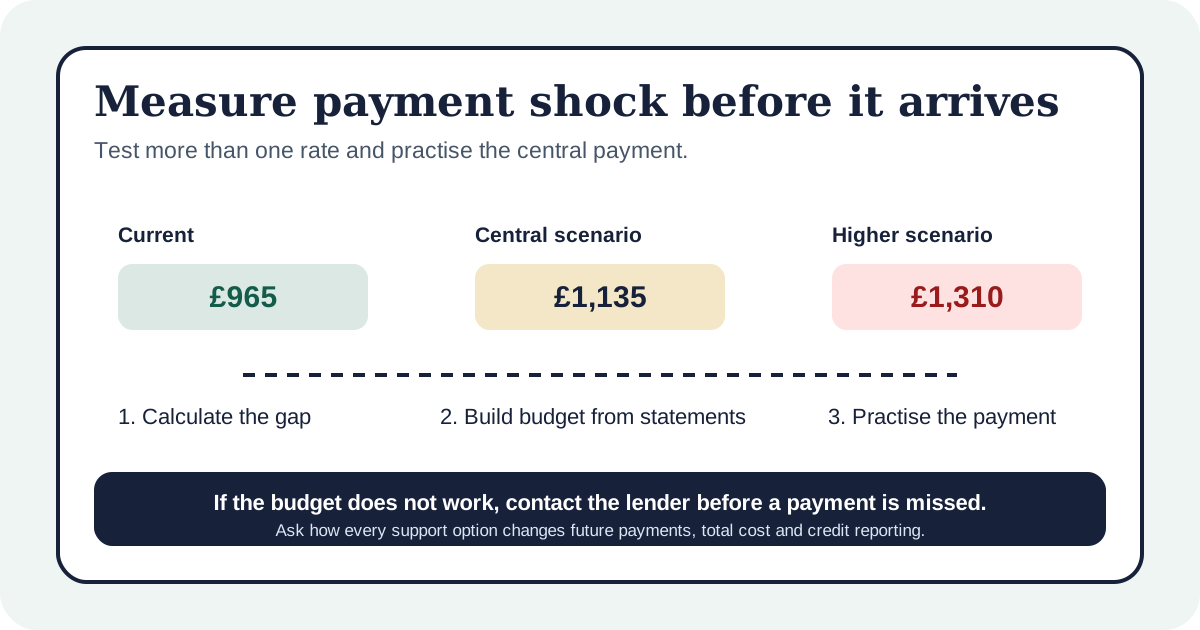
A household owes £172,000 with 19 years remaining. The current payment is £965. Its initial estimates are £1,135 on a new deal, £1,220 on a higher-rate scenario, and £1,310 on the lender's current reversion rate. The central increase is £170 a month.
The household reviews three months of transactions and finds £95 of subscriptions and flexible spending that it is comfortable reducing. It also has an annual-insurance reserve that was missing from the first draft, so only £55 of the apparent saving is truly available. It starts a £170 practice payment and discovers that £40 a month still has no reliable source.
Because the gap is found early, the borrowers compare product fees, ask the current lender about a product transfer, and speak to a regulated adviser. They do not use the entire emergency fund to force the lower payment. The final plan retains a reserve and includes a follow-up budget check after the first new direct debit.
Prepare for variable income
Self-employed, seasonal, commission-based, and zero-hours income should be tested using conservative figures. Separate the minimum reliable income from higher months and decide how surplus income will rebuild reserves or make optional overpayments. Do not set a required mortgage payment on the assumption that every bonus or overtime opportunity continues.
Check insurance and workplace support
Review existing income-protection, critical-illness, life, unemployment, or employer benefits before assuming no support exists. Check definitions, waiting periods, exclusions, and claim processes. Do not buy or cancel protection based on a generic article; regulated advice may be appropriate.
Warning signs that require faster action
- The budget only works by using credit for food or utilities.
- The practice payment is repeatedly withdrawn.
- Mortgage payments are already late or returned.
- Priority bills or council tax are unpaid.
- The household is considering a high-cost loan to meet the mortgage.
- A temporary arrangement is ending without a plan for the next payment.
- An interest-only term is nearing maturity without a repayment vehicle.
In these situations, contact the lender and use free debt-advice services promptly. Waiting for a missed-payment letter usually reduces the time available to consider options.
After the payment changes
Check the first statement and direct debit against the agreed rate, balance, term, and support arrangement. Update the budget with the actual amount. If the payment is lower than expected, direct the difference deliberately rather than allowing it to disappear. If it is higher, contact the lender immediately and ask for the calculation.
Bottom line
Mortgage payment shock becomes more manageable when it is measured early. Confirm the trigger date, model more than one rate, build the budget from real transactions, practise the new payment, and protect a cash reserve. When the figures do not work, contact the lender before missing a payment and obtain the consequences of every option in writing.
Worked example: model a higher payment and practise it
A household owes £172,000 with 19 years remaining and currently pays £965. It models payments at several possible rates, transfers the central £170 monthly increase into savings before the deal ends, and uses failed practice transfers as evidence that the budget needs further action.
Sources and further checking
Sources were checked on 27 July 2026. Provider pages illustrate product-specific practice and should not be treated as universal rules.
How this guide was produced
Pay Off Sooner may use software and generative AI to organise research, test structure, identify repeated wording and support drafting. The page is not published solely because an automated system produced text. Conor Dwyer selects the topic, checks cited sources, reviews calculations and examples, removes unsupported claims and accepts responsibility for corrections. Read the full editorial and automation policy.